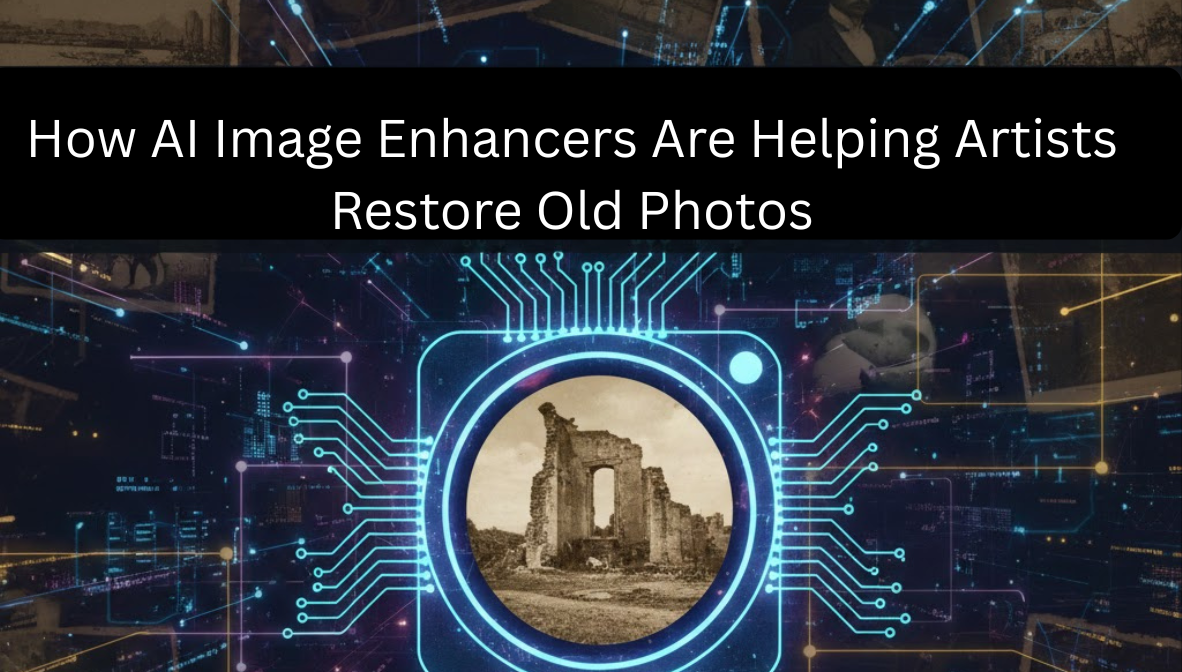
The world of digital art and photography has undergone remarkable changes in recent years, thanks to artificial intelligence (AI). One of the most significant breakthroughs has been the development of AI-powered image enhancers. These tools are making it easier for artists, photographers, and content creators to restore old and damaged photos to their original quality. What once seemed like a complex and time-consuming task is now accessible to anyone, regardless of their technical skills. In this article, we explore how AI image enhancers are helping artists restore old photos, ensuring that cherished memories and historic works of art are preserved in the best possible way.
What Is an AI Image Enhancer?
An AI image quality enhancer is a tool that uses artificial intelligence and machine learning algorithms to improve the quality of digital images. This tool is available in invideo’s AI platform and is capable of automatically adjusting the brightness, sharpness, resolution, and even repairing physical damage to images. AI image enhancers work by analyzing the existing pixels of an image, detecting patterns, and then applying sophisticated algorithms to enhance the image’s quality. The most impressive part is that AI can achieve these results without needing much human intervention, making it a game-changer in various fields like photo restoration, digital art, and design.
For old and damaged photos, the role of an AI image enhancer is even more crucial. Over time, physical photos can degrade due to exposure to light, moisture, or physical wear and tear. When scanned into digital format, these imperfections become more evident, and traditional restoration methods can be time-consuming and require significant manual effort. However, AI-driven restoration tools are designed to fix these imperfections, enhancing photo quality in a matter of seconds.
How AI Image Enhancers Are Revolutionizing Photo Restoration
AI has brought a wave of transformation to the photo restoration process, making it more efficient, accessible, and less reliant on technical expertise. Below, we explore some of the key ways in which AI image enhancers are helping artists restore old photos:
- Restoring Image Detail and Clarity
One of the biggest challenges in photo restoration is recovering lost details. Older photographs often suffer from low resolution, blur, or pixelation, particularly those taken with early cameras or scanned from aged prints. AI tools can quickly analyze an image’s pixel structure and fill in missing details. These tools improve the sharpness of the image and recover minute details like facial features, textures, and fine lines. As a result, a once blurry or pixelated image can be restored to a clearer, more defined state, making it appear as if the photo was taken with modern-day camera equipment.
The AI algorithms work by comparing the damaged areas of the image with a vast database of similar images. Using this data, the tool can predict what the original image may have looked like, and reconstruct details such as eyes, hair, and clothing that may have been distorted due to pixelation. - Correcting Faded or Altered Colors
Many old photos suffer from color fading over time. Whether it’s the yellowing of black-and-white photos or the loss of vibrancy in color photos, the fading process can significantly detract from the image’s overall appearance. AI image enhancers can automatically analyze the faded colors and correct them to restore the original hues.
AI color correction works by analyzing the image’s tonal and color distribution. With the help of deep learning models, AI can adjust the image’s color balance, brightness, and contrast to bring back the natural colors. It can even fix hues that were incorrectly captured or overexposed. For example, a photo that has turned yellowish over time can be transformed into a more neutral and true-to-life representation with just a few adjustments. - Repairing Physical Damage
One of the most challenging aspects of restoring old photographs is dealing with physical damage. Cracks, scratches, creases, and water stains are common in vintage photos, and repairing them manually can be an arduous and time-consuming task. AI image enhancers, however, make it easy to repair these damages automatically.
AI algorithms can detect physical damage by identifying the areas where the pixels are broken or disrupted. Using sophisticated inpainting and image reconstruction techniques, AI tools can fill in the missing sections by generating new pixels that match the surrounding areas. This process not only repairs the damage but does so in a way that makes the restoration look seamless and natural.
For instance, an old photograph with a large tear running through the middle can be restored by AI tools that automatically predict what the missing portion of the image might look like and replicate the surrounding textures, colors, and patterns. The result is a flawless photo with no visible traces of the original damage. - Upscaling Resolution
Old photos, especially those taken with early cameras, often have low resolution, which makes them unsuitable for modern use, such as printing or digital display. AI-powered upscaling tools can increase the resolution of old photos without sacrificing quality.
AI resolution upscaling works by analyzing the pixel structure of the original image and generating additional pixels based on the patterns in the existing data. The result is a high-resolution image with enhanced clarity and crispness, making it suitable for use in large prints, posters, or even digital galleries. Unlike traditional upscaling methods, AI upscaling ensures that the image quality remains intact, without introducing blurry or jagged edges.
For example, a photograph scanned at a low resolution can be upscaled to meet modern standards, while retaining the integrity of the original details. AI upscaling is especially useful for artists who want to print their restored photographs or incorporate them into high-quality digital projects. - Restoring Lost Texts and Details
In some cases, old photos may contain handwritten notes, text, or other small details that have become illegible over time due to fading or damage. AI image enhancers can also help restore these texts by improving legibility and enhancing fine details.
AI tools can analyze the text areas of the image and use optical character recognition (OCR) to recognize the letters and words. Once the text is identified, AI can adjust the contrast and sharpness around the text to make it more readable. This is particularly useful for preserving historical documents, letters, or personal notes embedded within photographs. - Efficient Workflow for Artists
For artists specializing in photo restoration, AI image enhancers offer an efficient and streamlined workflow. Instead of spending hours manually editing each photo, artists can use AI tools to handle the bulk of the restoration work. This allows them to focus on the finer details, such as enhancing compositions, adjusting color schemes, and applying artistic effects.
AI-powered restoration tools can handle tasks such as color correction, detail enhancement, and damage repair automatically, saving artists valuable time. The enhanced efficiency means that artists can work on more projects and produce higher-quality results in a fraction of the time.
The Role of AI in Creative Workflows
AI image enhancers are not just for photo restoration; they are also playing a key role in the broader creative workflows of artists and designers. These tools are becoming an integral part of digital art creation, where artists can use AI-enhanced photos as a foundation for their projects. AI can be used to create high-quality reference images, which artists can then build upon, transforming them into stunning digital paintings or other forms of artwork.
Additionally, AI tools like Invideo’s image enhancer can be used to fine-tune photo manipulation projects. Whether an artist is creating visual effects, combining multiple images, or working with scanned art, AI tools make the process faster and more efficient, while still delivering professional-level results.
Conclusion
AI-powered image enhancers are transforming the way artists restore old photos. Whether it’s recovering lost details, fixing color issues, repairing physical damage, or upscaling resolution, AI tools are making it easier to preserve precious memories and historical artifacts. Artists no longer need to spend hours manually restoring old photographs—AI tools do the heavy lifting, allowing them to focus on the creative aspects of their work. As AI technology continues to improve, the possibilities for photo restoration and enhancement will only expand, making it easier than ever to breathe new life into old images.